 Nile River Boat Cruise
Philae Temple: The Temple of Isis on Agilkia Island
The Philae Temple of Isis sits on Agilkia island near Aswan, reached by motorboat from the marina by the old Aswan Dam. This guide covers the temple's history, the UNESCO rescue that moved it stone by stone, what to look for on the island, the official ticket price, opening hours and the boat trip out. It also shows which Nile river cruises stop at Philae and whether their price covers the entrance fee. Figures come from official ministry price lists and the site's own cruise listings. The bookable tours are compared on all Nile river cruises.
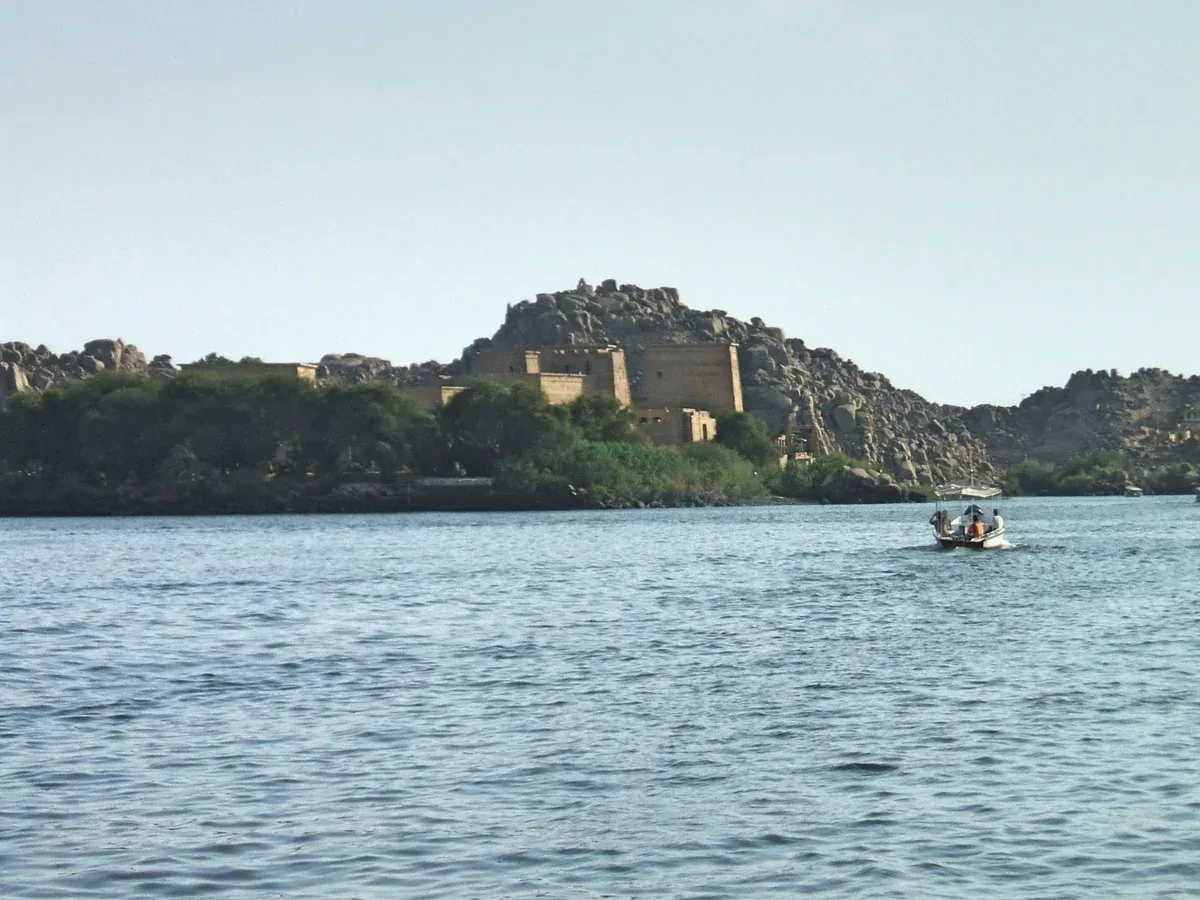
Philae Temple stands on its island and is reached by a short boat ride from Aswan. Photo: Pierre André Leclercq, CC BY-SA 4.0, via Wikimedia Commons
Quick answer Philae Temple at a glance
The Philae Temple costs EGP 550 for foreign adults and EGP 275 for students, and the site is open 7:00 to 16:00. It stands on Agilkia island, where it was rebuilt after a UNESCO operation moved about 40,000 blocks from the flooded original island. Access is by motorboat from the Philae Marina near the old Aswan Dam. Most cruises list Philae as a stop but exclude the entrance fee.
Key takeaways
- Compare sailings that stop at Philae in Nile River Boat Cruise.
- The 3-Night Cruise with Temple Tickets is one of the few listings where entrance fees are included.
- For the rest of the city, see things to do in Aswan.
- The dam that caused the flooding is covered in the Aswan High Dam guide.
The Temple of Isis and Its Island
Philae began as a small island in the Nile near Aswan and became one of Egypt's most important sanctuaries of the goddess Isis. It is also the site of one of the great monument rescues of the twentieth century.
How the Listings Compare
The table sets out the figures this section relies on, with the source of each.
| Date | What happened |
|---|---|
| 26th Dynasty | The oldest certain structure, a small kiosk of Psamtik II |
| 380 to 362 BC | The Temple of Isis begun under Nectanebo I |
| Ptolemaic era | Most surviving structures built |
| AD 394 | The last known hieroglyphic inscription written at Philae |
| 452 | The last known Demotic inscription |
| AD 537 | The temple officially closed under Justinian I |
| 1960 | UNESCO begins the Philae rescue project |
| 1974 | The relocation contract awarded to two Italian companies |
| 1977 to 1980 | The whole relocation operation, moving about 40,000 blocks |
| 1979 | UNESCO inscribes the Nubian Monuments from Abu Simbel to Philae |
| 10 March 1980 | Philae reopens on Agilkia island |
Origins and the Worship of Isis
The oldest certain structure on Philae is a small kiosk built by Psamtik II of the 26th Dynasty. The Temple of Isis itself took shape under Nectanebo I, who ruled from 380 to 362 BC, and most of the surviving buildings are Ptolemaic. Before the flooding, Philae island was no more than 380 m long and about 120 m broad, yet it held a dense cluster of temples, colonnades and kiosks.
The last known inscription in Egyptian hieroglyphs was cut here in AD 394, and the last known Demotic inscription followed in 452. Procopius records that the temple was officially closed in AD 537 by Narses under an order from Justinian I. Five of the Philae temples were converted into churches, and the Temple of Isis itself became a church of Saint Stephen. A Christian altar still stands in the first hypostyle hall.
The Flooding and the Rescue
The first threat came from the old Aswan dam downstream. When its sluices were closed, water backed up over the island, and the complex was out of the water only when the sluices were open from July to October. The Aswan High Dam, begun in 1960 and completed in 1970, made the situation permanent.
UNESCO began the Philae rescue project in 1960. Engineers built a coffer dam of two rows of steel plates filled with 1 million cubic metres of sand to dry out the site. The monuments were measured by photogrammetry before dismantling, and about 40,000 blocks weighing 2 to 25 tons each were moved.
The contract was awarded in 1974 to two Italian companies, and the whole relocation operation lasted from 1977 to 1980. The monuments were rebuilt on Agilkia, an islet on higher ground about 500 m away. The Agilkia site was raised 12.40 m above the original location, and the top of the island was cut to match Philae's old contours, so the temples still look as if they grew out of the rock.
Philae reopened on 10 March 1980. UNESCO inscribed the Nubian Monuments from Abu Simbel to Philae on the World Heritage list in 1979. For the dam itself, see the Aswan High Dam guide.
Timeline of the Island
The dates below trace Philae from its oldest buildings to the reopening on Agilkia. They come from the UNESCO project records and standard references for the site.
Sources: Philae, Wikipedia, Ministry of Tourism and Antiquities price list
What to See on Philae
The island packs a lot into a small area, and the visit runs roughly from Trajan's Kiosk through the pylons to the Temple of Isis.
Trajan's Kiosk
Trajan's Kiosk has 14 columns joined by a screening wall. The building measures 15 by 20 m and rises 15.85 m high, with the columns joined by a screening wall. It is attributed to Trajan, who ruled from 98 to 117 AD, though most of it may date earlier, to the reign of Augustus.
Locals call it Pharaoh's Bed.
The First Pylon and the Temple of Isis
The first pylon stands 18 m high and carries reliefs of Ptolemy XII making offerings to the gods. Behind it lies the first hypostyle hall, where a Christian altar survives from the years when the temple served as the church of Saint Stephen. The Temple of Isis itself is the centrepiece of the island, built from the reign of Nectanebo I onward and enlarged under the Ptolemies.
Look for the Coptic crosses and marks cut into the walls, the physical record of the temple's conversion to a church. The Mammisi, or birth house, and the colonnades on the east and west sides complete the main group.
The Last Inscriptions
Philae holds two records that make it special for anyone interested in writing. The last known inscription in Egyptian hieroglyphs was written here in AD 394, and the last known Demotic inscription was written in 452. Both date from the final centuries of temple religion in Egypt, when the island was one of the last places where the old gods were still worshipped in the old way.
The Panorama View
The ministry sells a separate panorama ticket at EGP 200 for foreign adults and EGP 100 for students, within the same 7:00 to 16:00 hours. Wikivoyage also lists a posted roof panorama ticket at LE200. Before flooding the island was no more than 380 m long and about 120 m broad.
For more of the city around it, see things to do in Aswan.
Island Temple of Isis, Philae | Egypt Documentary 4k
A short documentary on the island Temple of Isis at Philae and how it was moved. Third-party video by ODYSSEY VISUAL MEDIA. This site did not shoot it and has no relationship with the creator.
Boat, Tickets and Hours
Two costs apply to a Philae visit: the entrance ticket from the ministry and the motorboat from the marina. Budget both before you go.
How the Listings Compare
The table sets out the figures this section relies on, with the source of each.
| Ticket | Price | Hours |
|---|---|---|
| Philae foreign adult | EGP 550 | 7:00 to 16:00 |
| Philae student | EGP 275 | 7:00 to 16:00 |
| Philae panorama foreign adult | EGP 200 | 7:00 to 16:00 |
| Philae panorama student | EGP 100 | 7:00 to 16:00 |
| Motorboat round trip, 1 to 8 people | LE150 | Daytime, posted fare per Wikivoyage |
Tickets and Hours
The ministry price list shows Philae at EGP 550 for foreign adults and EGP 275 for students, open 7:00 to 16:00. The panorama ticket is listed separately at EGP 200 for foreign adults and EGP 100 for students, inside the same hours. Note that most Nile cruises do not include this fee in their fare, so check the inclusion line before booking.
The table gathers the official figures.
The Boat from the Marina
Access to the island is by motorboat from the Philae Marina near the old Aswan Dam. Wikivoyage lists a posted daytime motorboat fare of LE150 round trip for 1 to 8 people, so a group can share one boat and split the cost. Aswan's average summer highs stay above 40 C, and the record is 51 C in July 1918, so shade and water matter.
For more time on the river, see the Overnight Felucca from Aswan.
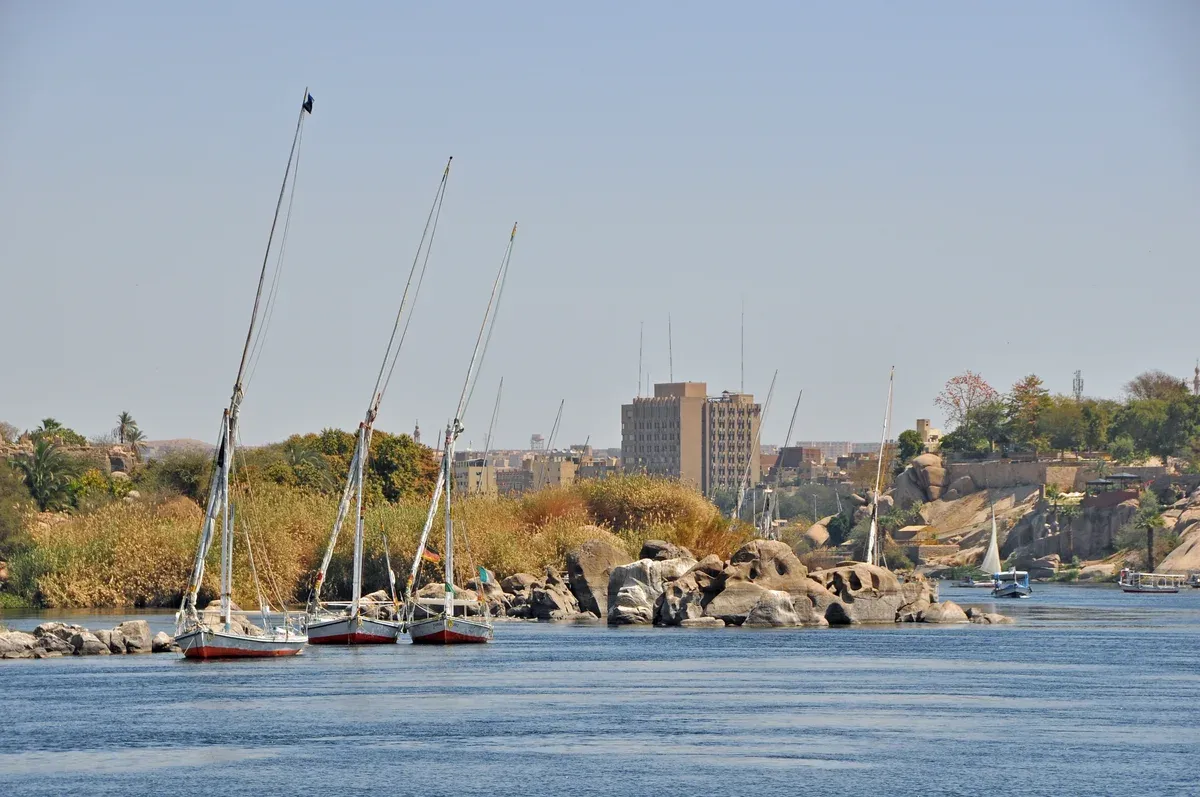
Several feluccas are moored on the Nile at Aswan. Photo: Marc Ryckaert, CC BY 3.0, via Wikimedia Commons
Philae on a Nile Cruise
Almost every Aswan departure lists Philae as a stop. The catch is that on most listings the entrance fee is not in the price, so you pay the EGP 550 ticket yourself on the day.
The Honest Breakdown
Most 3-night and 4-night cruises name Philae in their itinerary and then exclude entrance fees. The 3-Night Cruise with Abu Simbel and Balloon at $340 plus $110 in mandatory checkout charges, the 4-Night Luxor to Aswan Cruise at $950 plus $100.83 in mandatory checkout charges and the Nile Cruise from Cairo with Flights at $1,300 all exclude the fee at every sight they name, including Philae. Several listings do cover it.
The Luxury Dahabiya Cruise at $1,100 includes entrance fees for the sites on its itinerary, which covers Philae. The 3-Night Cruise with Temple Tickets at $600 includes all entrance fees to its named sights, Philae among them, though Abu Simbel is not part of its price.
How the Philae Stop Works
Where the Aswan departures list it, Philae comes on day 1, as on the 3-Night Cruise with Temple Tickets. On the 4-Night Luxor to Aswan Cruise it comes on day 5. Access is by motorboat from the Philae Marina near the old dam.
If your fare excludes the ticket, expect to pay the EGP 550 entry yourself. Read the inclusion line on each listing carefully, because phrasing varies from 'paid locally' to 'excluded'. Compare all the sailings in Nile River Boat Cruise before you choose.
Philae Tips: Do and Don't
Five things worth doing and four to avoid, each drawn from the documented facts about the site.
Do
- Do go early, because the site opens at 7:00 and closes at 16:00, and Aswan's summer highs stay above 40 C.
- Do ask about the panorama ticket at EGP 200 if you want the roof view, since the ministry sells it separately.
- Do look for the Coptic crosses and marks, because five Philae temples became churches and the Temple of Isis served as the church of Saint Stephen.
- Do share the motorboat, because the posted round trip fare of LE150 covers 1 to 8 people.
- Do check whether your cruise includes entrance fees, because most listings exclude the EGP 550 ticket and only a few fares cover it.
Don't
- Don't arrive after 16:00, because the ministry list shows the site closes then and the daytime motorboat fare is posted for daytime only.
- Don't assume a temple visit means a covered ticket, because most cruise listings name Philae but pay for entry separately.
- Don't assume the sound and light show runs at a fixed hour, because winter shows usually start between 6:00 and 7:00 pm and summer shows around 8:00 or 9:00 pm, so confirm the schedule with the seller.
- Don't plan a quick visit and a second stop the same morning at a fixed time, because the boat leg from the marina adds travel time.
Philae Temple Questions
Why was the Philae Temple destroyed?
It was not destroyed in a single event. Procopius says the temple was officially closed in AD 537 by Narses under an order from Justinian I, after which five Philae temples became churches and the Temple of Isis served as the church of Saint Stephen. The modern threat was water, which the rescue move to Agilkia solved. See the timeline in the guide above.
Is the Philae Temple worth visiting?
The site is open 7:00 to 16:00, costs EGP 550 for foreign adults and combines reliefs such as Ptolemy XII making offerings with records like the last known hieroglyphic inscription of AD 394. It is a regular stop on the Aswan stretch of a Nile river cruise.
What was the Philae Temple used for?
It was the sanctuary of Isis, begun under Nectanebo I between 380 and 362 BC and enlarged under the Ptolemies. After the temple closed in AD 537 it was used as a church, and a Christian altar still stands in the first hypostyle hall. The Luxury Dahabiya Cruise includes a Philae stop with entrance fees covered.
How do I get to the Philae Temple from Aswan?
Access is by motorboat from the Philae Marina near the old Aswan Dam, with a posted daytime round trip fare of LE150 for 1 to 8 people per Wikivoyage. The site opens 7:00 to 16:00. Several sailings such as the 3-Night Cruise with Abu Simbel and Balloon include the transfer as part of the itinerary.
When was Philae moved to Agilkia?
The whole relocation operation lasted from 1977 to 1980, moving about 40,000 blocks of 2 to 25 tons each to Agilkia about 500 m away, and the site reopened on 10 March 1980. The Agilkia ground was raised 12.40 m to match the original contours. Compare cruises that call there in Nile River Boat Cruise.
How much is the Philae sound and light show?
The show lasts about 45 to 60 minutes, with winter start times usually between 6:00 and 7:00 pm and summer around 8:00 or 9:00 pm. A current ticket price is not stated in official sources, so confirm the schedule and price with the seller before you go. Daytime visits are covered on pages such as the 3-Night Cruise with Temple Tickets.