 Nile River Boat Cruise
Edfu Temple: Visiting the Temple of Horus
The Edfu Temple is the Temple of Horus, the falcon god, and it stands on the west bank of the Nile about halfway along the classic cruise route between Luxor and Aswan. It is the most completely preserved temple in Egypt, built between 237 BC and 57 BC, with its pylon, courts, halls and sanctuary still in place. This guide covers the building, the reliefs, the tickets, the horse carriage ride from the river and the cruises that stop here. For the double temple downriver, see Kom Ombo Temple. The bookable tours are compared on Nile river cruises.
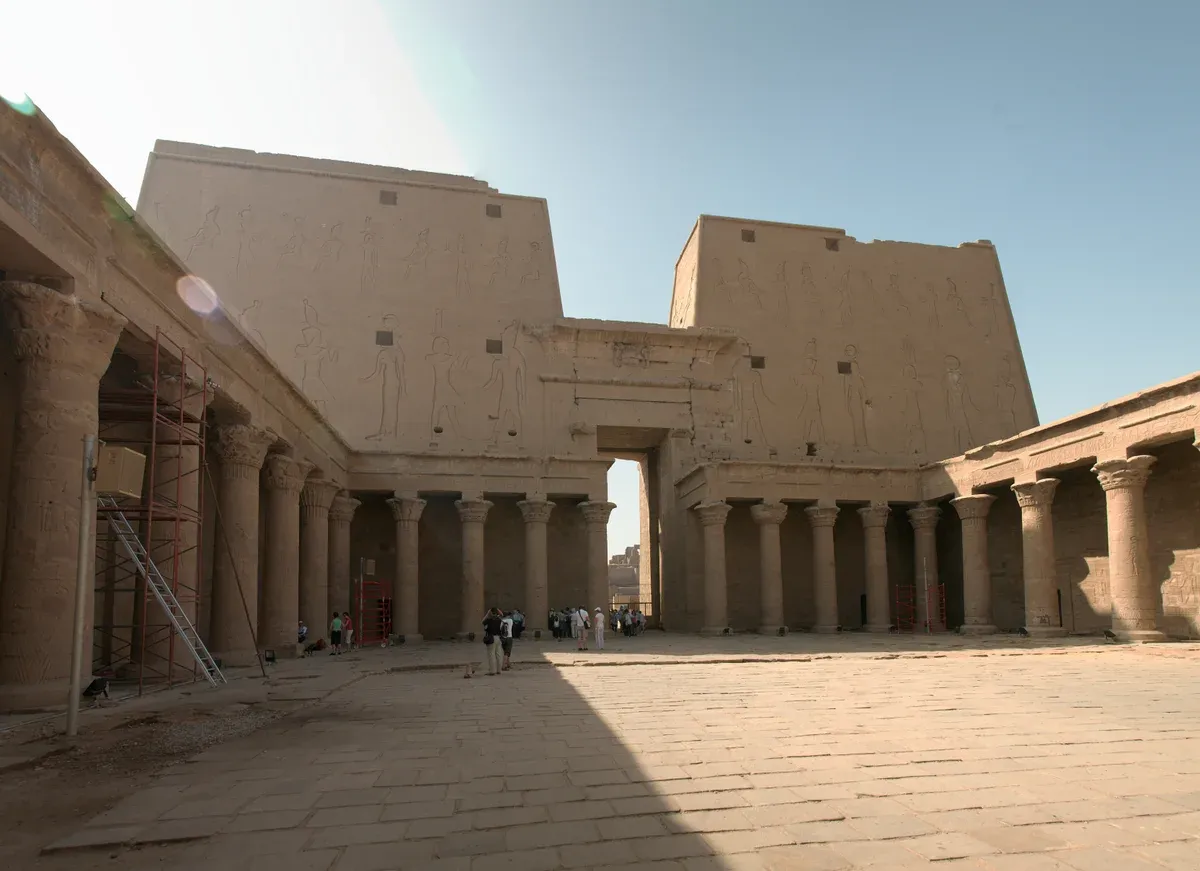
The pylon of the Edfu temple rises behind the colonnaded court. Photo: MatthiasKabel, CC BY-SA 3.0, via Wikimedia Commons
Quick answer Edfu Temple at a glance
The Temple of Horus at Edfu is the most completely preserved temple in Egypt, built between 237 BC and 57 BC under the Ptolemies. Cruise ships dock at riverside quays and horse-drawn carriages take visitors to the temple gates.
Key takeaways
- Tickets cost EGP 550 for foreign adults and EGP 275 for students, and the temple is open 7:00 to 17:00. See the full ticket and hours section in Tickets, Hours and Getting In.
- Most Nile river cruises on the Luxor to Aswan route call at Edfu. The 3-Night Cruise with Temple Tickets includes the entrance fee at $600 per person.
- The temple took about 180 years to build. Read the dates and builders in The Temple of Horus.
- Two granite falcon statues of Horus flank the pylon gate, and the court has 32 columns. The next temple upriver is covered in Kom Ombo Temple.
The Temple of Horus
Edfu was the cult centre of Horus of Edfu, and Greek and Roman writers called the town Apollonopolis Magna. The temple stands on the west bank of the Nile between Esna and Aswan, in a town of about 60,000 people.
When It Was Built and By Whom
Construction of the Temple of Horus began on 23 August 237 BC under Ptolemy III Euergetes. The last work finished in 57 BC under Ptolemy XII Auletes, and the Egyptian ministry says the temple was completed about 180 years after construction began. The temple rose over the site of a smaller New Kingdom temple.
The work moved in stages. The inner hall is the oldest part of the temple, begun by Ptolemy III in 237 BC. Work on the pronaos started in 140 BCE. The outer hypostyle hall was completed in 122 BC, and the whole temple was finished in 57 BC. The temple was consecrated for the first time on 10 September 142 BCE and a second time in 70 BCE.
The temple fell out of religious use after Theodosius I issued an edict in 391 CE. Sand and settlement debris then buried the building almost to the top. A French expedition identified the temple in 1798, when only the tops of the pylons showed above the ground. Auguste Mariette began freeing the temple from sand in 1860. A visitor centre and paved car park were added in 2005, and lighting installed in late 2006 allows night visits.
The settlement around the temple was the capital of the Second Upper Egypt nome. The ancient mound of Tell Edfu, which rises up to 20 m beside the temple, has been excavated by a project directed by Nadine Moeller since 2001.
The Pylon, the Courts, the Halls and the Sanctuary
The temple follows the classic plan, and almost every part survives, which is why Wikipedia calls it the most completely preserved temple in Egypt. You walk from the great pylon through an open court, then two columned halls, then toward the dark sanctuary at the rear. The pylon towers are planned as mirror images of each other and carry scenes of Ptolemy XII conquering his enemies and worshipping deities. Two statues of Horus as a falcon flank the entrance gate of the first pylon.
Behind the pylon, the reliefs show the Feast of the Beautiful Meeting, when Horus of Edfu was united with Hathor of Dendera. Wikipedia records that Hathor travelled south from Dendera each year to visit Horus at Edfu, marking their sacred marriage. The walls also carry the Edfu building texts, which describe how the temple was built and call the site the Island of Creation, and the Sacred Drama about the conflict between Horus and Seth.
The figures below come from the temple plan published by ancient-egypt.co.uk, the Madain Project and Wikipedia. Use them as a walking order for a visit.
| Part | What you see | Figure |
|---|---|---|
| Pylon | Mirror-image towers with scenes of Ptolemy XII, guarded by two falcon statues of Horus at the gate | 2 falcon statues |
| Peristyle court | The Court of Offerings, an open court ringed by columns | 32 columns |
| Outer hypostyle hall | First roofed hall, completed in 122 BC | 12 columns |
| Second hypostyle hall | Deeper than it is wide, the inner hall is the oldest part, begun in 237 BC | 12 columns |
| Sanctuary | Barque sanctuary surrounded by chapels, with a polished black granite shrine and an offerings table | 9 chapels |
| Nilometer | Reached by steps under the outer wall, used by the priesthood to tally tithes from river readings | not stated |
Inside the Sanctuary
The sanctuary sits at the centre of the temple and holds a shrine of polished black granite and an offerings table. Around it stand nine chapels. A granite naos of Nectanebo II from an earlier building stands in the inner sanctuary, a survivor of the New Kingdom temple that once occupied the site.
The barque sanctuary was the spiritual core of the building. The sanctuary is surrounded by nine chapels. Because the temple lay buried for so long, these rooms survive largely intact.
Sources: Nile, Wikipedia, Aswan, Wikipedia
Tickets, Hours and Getting In
The Egyptian ministry publishes ticket prices for Edfu, and cruise passengers reach the temple from the riverside quays by horse carriage.
Official Ticket Prices and Hours
The Egyptian ministry lists Edfu at EGP 550 for foreign adults, EGP 275 for students and EGP 40 for Egyptian adults. Carry Egyptian pounds, the official currency of Egypt, since LiveAboard advises using it for most personal expenses.
The ministry lists the temple as open from 7:00 to 17:00. Lighting was installed at the temple in late 2006, which allows night visits.
| Ticket | Price | Hours |
|---|---|---|
| Foreign adult | EGP 550 | 7:00 to 17:00 |
| Student | EGP 275 | Same as above |
| Egyptian adult | EGP 40 | Same as above |
From the Quay to the Temple Gate
Cruise ships dock at riverside quays in Edfu, and horse-drawn vehicles take visitors to the temple. The 2-Night Small-Group Cruise even lists a horse and carriage ride to Edfu as a feature of its itinerary.
How long you get depends on your boat. The listings in this guide's comparison table do not state a fixed Edfu stop length, though the 3-night felucca option on the Overnight Felucca from Aswan allows about 1 hour at Edfu. On a cruise ship you should expect the guide to set a meeting time and keep the group moving.
Heat and light matter. Edfu sits in Upper Egypt, where Aswan's average daily high reaches 41.9 C (107.4 F) in July and even January averages a high of 23.2 C (73.8 F). The cooler months from October to April are the comfortable window because temperatures are milder. Inside the halls the light drops fast, so give your eyes a moment at each threshold.
Visiting the Temple of Horus at Edfu, Egypt
A traveller walks through the Temple of Horus at Edfu and shows the pylon, the court and the halls. Third-party video by Traveling with Luigi. This site did not shoot it and has no relationship with the creator.
Edfu on a Nile Cruise
Edfu is a standard stop on the classic Luxor and Aswan route. LiveAboard lists the classic Luxor to Aswan itinerary with stops at Edfu and Kom Ombo as the most popular choice for first-time Nile cruisers.
Which Cruises Stop at Edfu
Most cruises on this site list Edfu among their stops, in both directions. The comparison below pulls the price and the Edfu ticket situation straight from each listing, so you can see whether the entrance fee sits inside the fare or waits for you at the gate. Ticket prices at the site itself are EGP 550 for foreign adults and EGP 275 for students per the ministry.
Read the entry column carefully. Only some fares cover temple tickets. The 3-Night Cruise with Temple Tickets at $600 per person includes all entrance fees to the sights it names, Edfu among them. The Luxury Dahabiya Cruise at $1,100 per person also covers entrance fees for the sites on its itinerary, and it stops at Edfu on a small sailing boat instead of a big ship. On the 4-night upstream direction, the 4-Night Luxor to Aswan Cruise at $950 per person, plus $100.83 in mandatory charges at checkout, lists Edfu, Kom Ombo and Philae as paid on site.
A 3-Night Cruise with Private Guide at $450 per person and a 3-Night Cruise with Balloon Ride at $580 per person both call at Edfu with tickets paid locally. The full side-by-side list of departures, prices and inclusions sits in Nile river cruises.
| Cruise | Price | Direction | Edfu ticket |
|---|---|---|---|
| 3-Night Cruise with Temple Tickets | $600 | Aswan to Luxor | Included |
| Luxury Dahabiya Cruise | $1,100 | Aswan to Luxor | Included |
| 4-Night Luxor to Aswan Cruise | $950 | Luxor to Aswan | Paid on site |
| 3-Night Cruise with Private Guide | $450 | Aswan to Luxor | Treat as not included |
| 2-Night Small-Group Cruise | $590 | Aswan to Luxor | Not included |
What a Stop Here Looks Like
A typical Edfu call follows one shape. The ship ties up at the quay, passengers come ashore, and horse-drawn vehicles carry them through town to the temple. Back at the pier, the boat sails on toward Kom Ombo, which lies on the Nile 50 km (31 mi) north of Aswan, or downriver toward Esna and Luxor.
Timing varies with the direction. The Esna lock can add a wait of an hour or more, and operators factor it into itineraries. Either way, stop times vary by sailing. Ask your guide what time the ship sails before you walk into the temple, because the return carriage plus boarding takes time.
If you want a slower day, the 3-night option on the Overnight Felucca from Aswan stops at Edfu for about 1 hour under sail, entry tickets excluded. The $25 from-price belongs to the shortest option, not the 3-night trip. For the next temple upriver with its double entrance, the guide lives at Kom Ombo Temple, and the temple beside the lock is covered at Esna Temple.
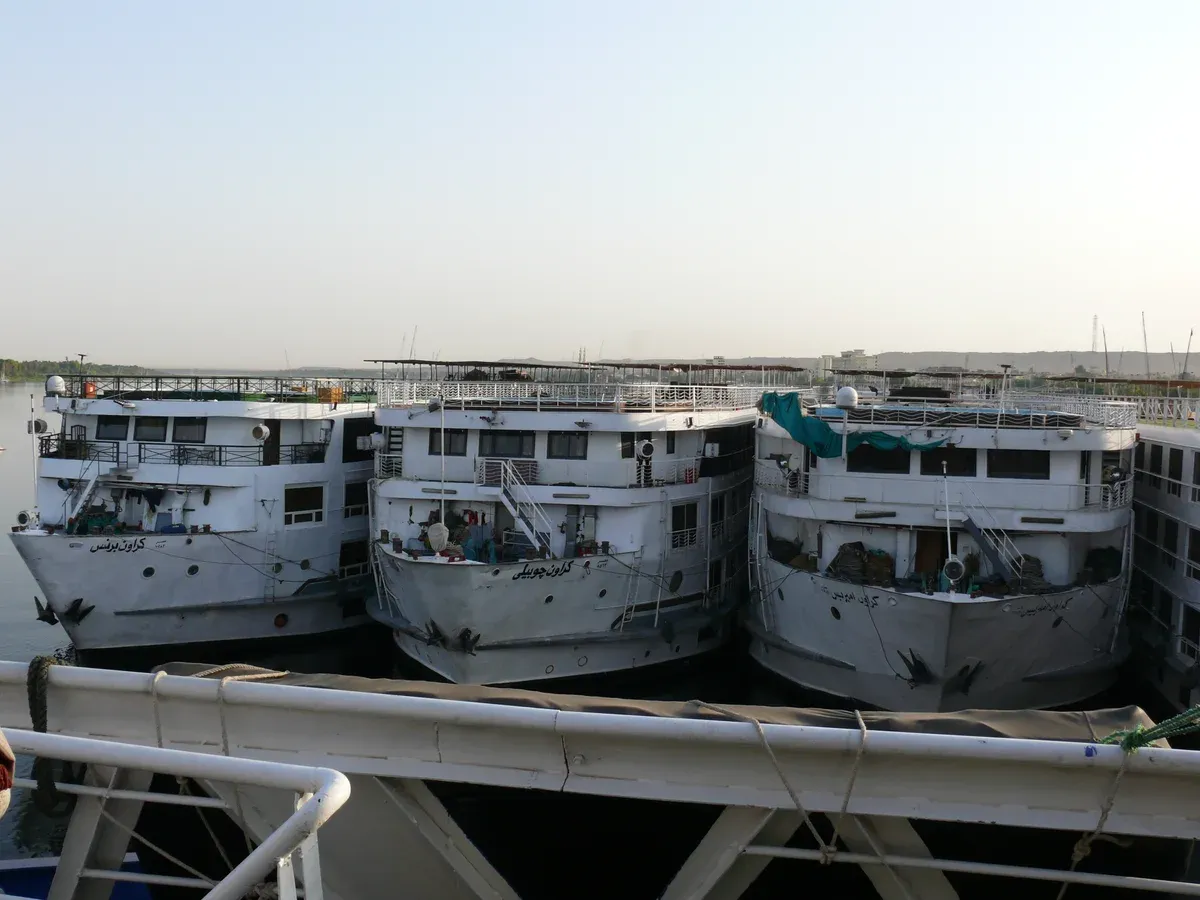
Several Nile cruise ships are tied up side by side in Aswan. Photo: Ad Meskens, CC BY-SA 3.0, via Wikimedia Commons
Do and Don't at Edfu
Do
- Do carry Egyptian pounds in cash for the ticket, because the Egyptian pound (EGP) is the official currency and LiveAboard advises using it for most personal expenses.
- Do cover shoulders and knees, because LiveAboard says shoulders and knees should be covered when visiting religious sites in Egypt.
- Do plan for heat and sun, because Aswan's average daily highs pass 41 C from June to August, and LiveAboard advises sunscreen, a hat and sunglasses.
- Do wear comfortable walking shoes, because the temple route runs from the pylon through a 32-column court and two 12-column halls to the sanctuary.
- Do check whether your cruise fare covers the entrance fee, because most listings exclude temple tickets and only some fares, such as the $600 3-Night Cruise with Temple Tickets, include them.
Don't
- Don't fly a drone here, because the FCDO says flying a drone without Ministry of Defence permission is illegal, with up to 7 years' prison or fines of EGP 5,000 to 50,000.
- Don't assume the carriage ride is included in every fare, because only some listings name it.
- Don't linger past your guide's meeting time, because the ship continues toward the Esna locks or Kom Ombo on a schedule the operator has set.
- Don't visit at midday in summer if your itinerary allows a choice, because LiveAboard says June to August brings intense heat and the cooler months from October to April are the comfortable season.
Edfu Temple FAQ
What is the Temple of Horus at Edfu?
It is a Ptolemaic temple dedicated to the falcon god Horus, built between 237 BC and 57 BC on the west bank of the Nile between Esna and Aswan, and it is the most completely preserved temple in Egypt. The full history sits in The Temple of Horus.
How much does the Edfu temple ticket cost?
The Egyptian ministry lists Edfu at EGP 550 for foreign adults and EGP 275 for students, open 7:00 to 17:00. The prices are set out in Tickets, Hours and Getting In.
How do cruise passengers get to Edfu temple from the ship?
Cruise ships dock at riverside quays in Edfu and horse-drawn vehicles take visitors to the temple. The 2-Night Small-Group Cruise names the carriage ride as part of its itinerary.
Which Nile cruises stop at Edfu?
Most cruises between Luxor and Aswan list Edfu among their stops, including the 3-Night Cruise with Temple Tickets at $600 per person and the 4-Night Luxor to Aswan Cruise at $950 per person. LiveAboard calls the classic Luxor to Aswan route with Edfu and Kom Ombo the most popular choice for first-time cruisers.
Why is the Edfu temple so well preserved?
The temple was buried under sand and settlement debris for centuries after it fell out of religious use in 391 CE, which protected it until Auguste Mariette began freeing it from sand in 1860. Its survival story is told in The Temple of Horus.
What should I see first at Edfu?
Start at the pylon with its two falcon statues of Horus, then cross the Court of Offerings with 32 columns, pass the two hypostyle halls of 12 columns each and end at the granite shrine in the sanctuary. The walking order is laid out in The Pylon, the Courts, the Halls and the Sanctuary.