 Nile River Boat Cruise
Nubian Village Aswan: A Visitor Guide
A Nubian village near Aswan is one of the easiest culture stops to add to a Nile river cruise. The houses are domed mud brick, many painted blue, and most visitors arrive by motorboat because there is no road into Gharb Soheil. This guide covers who the Nubians are, why the dams displaced them, how to reach the villages on the west bank and on Elephantine Island, and what the Nubia Museum in Aswan costs and when it opens. It also names the cruises that list a Nubian village stop and what their prices cover. The bookable tours are compared on Nile cruises.
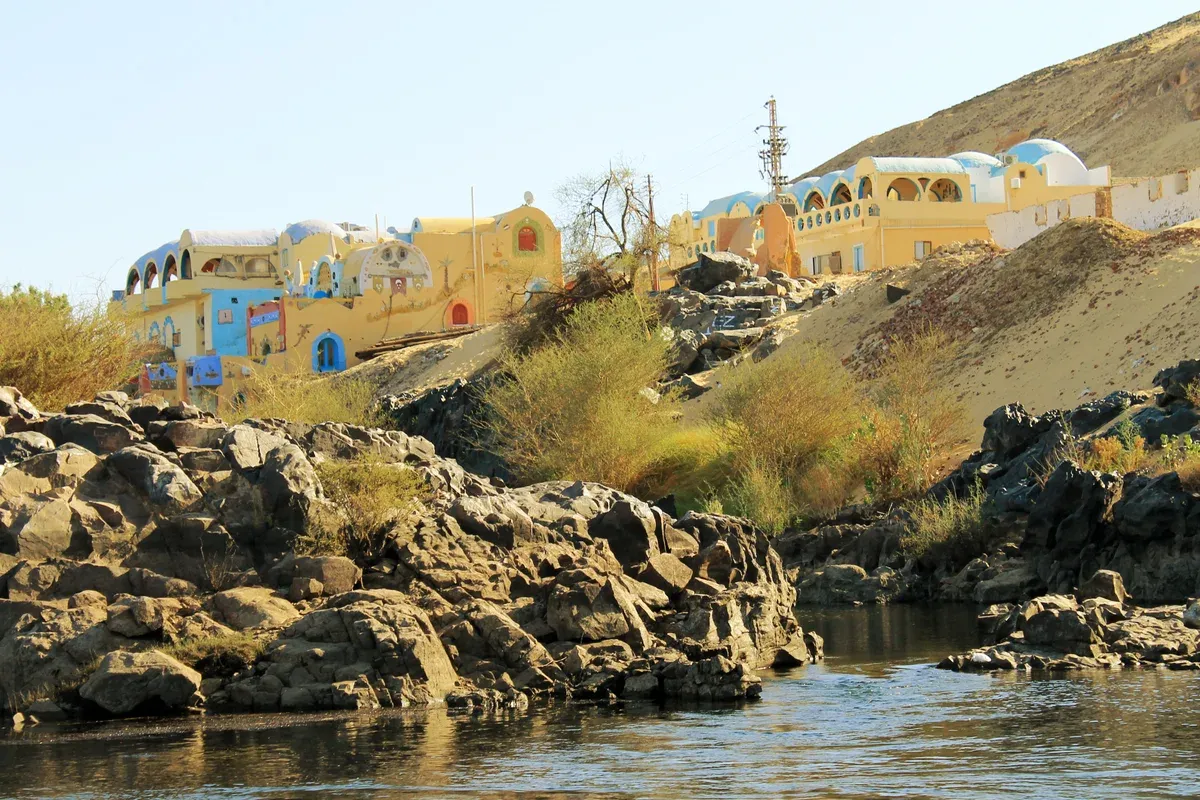
Painted Nubian houses sit on the rocky west bank of the Nile at Aswan. Photo: Belmahdy, CC BY-SA 4.0, via Wikimedia Commons
Quick answer Nubian village Aswan at a glance
A Nubian village near Aswan, best known at Gharb Soheil on the west bank, is reached by motorboat since cars cannot reach it. The Nubia Museum in Aswan charges EGP 400 for foreign adults and opens 9:00 to 17:00. On the cruises compared here, the 7-Day Luxor and Aswan Cruise lists the Nubian Village as a stop at $1,772 per person.
Key takeaways
- Gharb Soheil is a Nubian community on a sandy slope west of the Nile, established after the old Aswan Dam was built in 1902, and the only way in is by motorboat. See things to do in Aswan.
- The 7-Day Luxor and Aswan Cruise includes a Nubian Village boat trip in a 7-day itinerary, temple tickets excluded.
- The 4-Night Luxor to Aswan Cruise lists the Nubian Village as an optional extra paid on site at $950 per person.
- The Nubia Museum in Aswan costs EGP 400 for foreign adults and EGP 200 for students, open 9:00 to 17:00. Compare all sailings in Nile river cruise.
Who the Nubians Are
Nubians are an African people of the far south of Egypt and northern Sudan, with their own language and a building tradition older than the dams that displaced them.
Language and Origins
The Nubian language best documented today is Nobiin, which belongs to the Nilo-Saharan family and counts about 690,000 native speakers. It has no standardised orthography, which means spelling varies and written material is limited. One Nobiin-speaking community lives near Kom Ombo, downstream of Aswan, a result of the resettlement described below.
Old Nubian, ancestral to Nobiin, survives in early Christian manuscripts.
- Nobiin: Nilo-Saharan family, about 690,000 native speakers
- Old Nubian: ancestral to Nobiin, known from Christian-era manuscripts
- A Nobiin community lives near Kom Ombo today
Building Traditions
Nubians are credited with inventing the Nubian vault, a roofing technique. Village houses near Aswan today are domed mud brick. Many village houses are domed mud brick and painted blue, and in Gharb Soheil some homes have become guesthouses, so staying overnight is possible for travelers who want more than a boat trip.
- The Nubian vault is a mud brick roofing method credited to Nubian builders
- Village houses are domed mud brick, many painted blue
- Many Gharb Soheil homes now run as guesthouses
Displacement by the Dams
The dams changed Nubian life twice. Gharb Soheil itself was established after the old Aswan Dam was built in 1902. The far bigger rupture came with the Aswan High Dam, begun on 9 January 1960 and completed on 21 July 1970.
Wikipedia says the dam displaced 100,000 Nubians in Egypt and Sudan combined. About 50,000 Nubians were moved in Egypt to New Nubia near Kom Ombo and Edfu, and in Sudan 50,000 to 70,000 were moved, including to New Wadi Halfa. Egypt began compensating displaced Nubians in 2019 and 2020.
The story behind the dam itself is covered on the Aswan High Dam page.
Sources: Nubians, Nobiin language, Aswan Dam
Visiting a Nubian Village
Two clusters of villages matter for visitors: Gharb Soheil on the west bank and the three Nubian villages on Elephantine Island.
Getting There by Boat
Gharb Soheil sits on a sandy slope west of the Nile and cannot be reached by car, so visitors go by motorboat. Boatmen can be contacted on the Aswan Corniche, where Wikivoyage says boatmen can be contacted for felucca trips. A felucca, the traditional lateen-sailed wooden boat, typically carries eight to ten passengers with a crew of two or three, and feluccas remain in active use in Aswan despite motorboats and ferries.
For a ride around the islands rather than the west bank, the Aswan Felucca to Elephantine sails for $15 per person for about 2 hours, with no entry ticket needed for the sailing itself.
What You See
The draw is the setting and the houses. Gharb Soheil is a Nubian community on a sandy slope west of the Nile, with domed mud brick houses, many painted blue. Many households keep crocodiles as pets, and many homes now operate as guesthouses.
On Elephantine Island, about 1.2 to 1.6 km long and roughly 400 to 450 m wide, three Nubian villages stand among far older ruins, so a single boat trip can combine ancient sites and a living village.
- Gharb Soheil: no road access, motorboat only
- Houses: domed mud brick, many painted blue
- Crocodiles kept as pets in many households
- Elephantine Island holds three Nubian villages
Is It Worth Visiting
The village offers something the temples do not: a living community with its own language and architecture, reachable in a short boat ride from Aswan. Travelers who want depth beyond the boat trip can add the Nubia Museum, which puts the displaced heritage in one building, or stay in a Gharb Soheil guesthouse overnight. Aswan's summer highs stay above 40 C, so a village trip is most comfortable in the cooler months.
Sources: Aswan, Wikivoyage Aswan
Nubian Village Tour in Aswan Egypt
A couple tours a Nubian village in Aswan and shows the houses and daily life. Third-party video by DOUG and NIKI. This site did not shoot it and has no relationship with the creator.
The Nubian Museum
The Nubia Museum in Aswan preserves the heritage that the reservoir covered, and it is a structured way to understand the villages before or after a boat trip.
The Building and the Collection Context
The Nubia Museum was inaugurated on 23 November 1997 and won the Aga Khan Award for Architecture in 2001. Egyptian architect Mahmoud El-Hakim designed it, and the site covers 50,000 square metres. It stands in Aswan city, so it pairs easily with a morning boat trip to a village on the river.
| Ticket | Price | Hours |
|---|---|---|
| Foreign adult | EGP 400 | 9:00 to 17:00 |
| Student | EGP 200 | 9:00 to 17:00 |
Tickets and Opening Hours
The figures in the table come from the Egyptian ministry price list, the official source used across this site for site tickets. For comparison on the same list, Elephantine Island costs EGP 200 for foreign adults and Philae costs EGP 550, so the museum sits between the two. Student tickets run at half the adult price.
Hours are 9:00 to 17:00.
Sources: Nubian Museum, Ministry price list
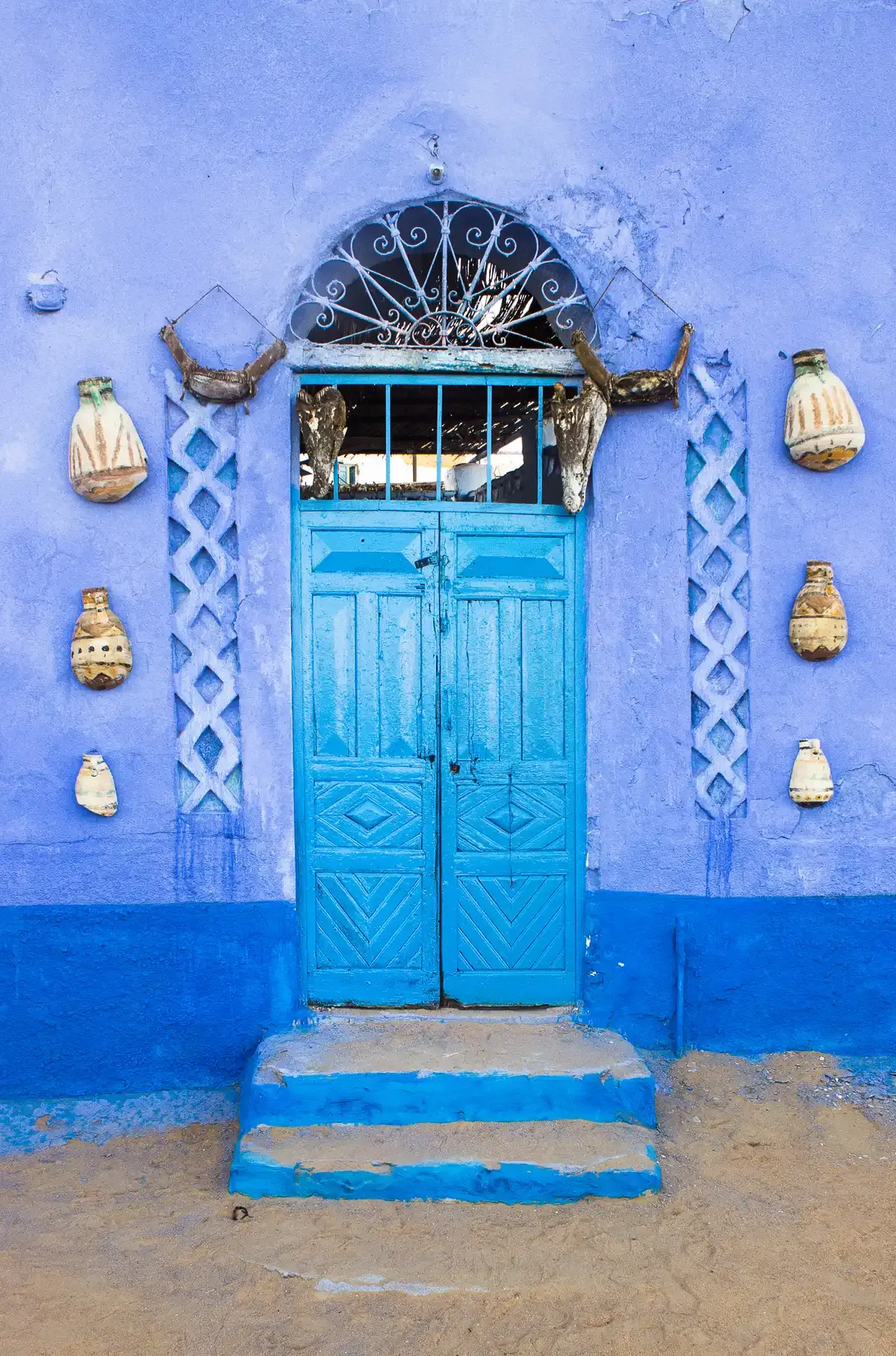
A Nubian house in Aswan has a blue door and pots on the painted wall. Photo: Yasseralaamobarak, CC BY-SA 4.0, via Wikimedia Commons
Nubian Villages on a Nile Cruise
Most 3 and 4-night cruises between Aswan and Luxor do not list a Nubian village. Two cruises in the comparison do, and the terms differ between them.
Cruises That List a Nubian Village Stop
The 7-Day Luxor and Aswan Cruise names the Nubian Village among its stops, with Abu Simbel and a Luxor balloon flight, at $1,772 per person for 7 days and 6 nights. Its listing says temple entrance fees are excluded, so budget village and temple tickets separately. The 4-Night Luxor to Aswan Cruise lists the Nubian Village as an optional extra paid on site, at $950 per person for 5 days and 4 nights, with $100.83 in mandatory charges added at checkout, and its temple fees are also paid on site.
Both cruises include hotel pickup and full board.
| Cruise | Price | Nubian Village | Tickets |
|---|---|---|---|
| 7-Day Luxor and Aswan Cruise | $1,772 per person | Listed stop with a boat trip | Temple fees excluded |
| 4-Night Luxor to Aswan Cruise | $950 per person | Optional extra, paid on site | Temple fees paid on site |
What the Price Covers
Neither cruise bundles the Nubian village ticket into the card price. On the 7-day sailing the stop is in the itinerary but entrance fees to temples are excluded, and nothing in the listing says a village entry fee is covered. On the 4-night sailing the village is explicitly an optional extra paid on site, and Karnak, Edfu, Kom Ombo and Philae are all paid on site too.
Travelers who want a village visit without committing to a multi-day cruise can arrange a motorboat from Aswan independently, or read the site-wide breakdown of what a Nile river cruise price covers before booking. Prices in this section are the US dollar card prices from the listings. The museum and site tickets above are in Egyptian pounds from the ministry price list.
Sources: tour listings and the ministry price list
Do and Don't Near the Villages
Do
- Do go by motorboat, because Gharb Soheil cannot be reached by car and the river is the only way in.
- Do visit the Nubia Museum first, because its 50,000 square metre site and collection explain the displacement you will hear about in the villages.
- Do plan the trip for the cooler months, because Aswan's summer highs stay above 40 C.
- Do consider a guesthouse in Gharb Soheil, because many homes there have become guesthouses and an overnight stay beats a rushed stop.
- Do carry local currency for tickets, because the Nubia Museum charges EGP 400 for foreign adults and the cruise listings pay village and temple fees on site.
Don't
- Don't assume the village ticket is in your cruise price, because the 7-day listing excludes temple fees and the 4-night listing calls the village an optional extra paid on site.
- Don't try to drive to Gharb Soheil, because there is no car access and visitors go by boat.
- Don't handle the pet crocodiles without asking, because they are live animals kept by households, not exhibits.
- Don't skip the museum if you have only one day in Aswan, because it condenses Nubian history that the villages show only in fragments.
Where to Stay in Aswan
Each link opens the live room list for that place on the booking site, with today's prices. Most Nile cruises from Aswan start with a hotel pickup in the city, so a night before the sailing is common.
Aswan Corniche
- Suits
- City hotels along the riverfront
Wikivoyage says felucca boatmen can be contacted on the Corniche, the start of most river trips in Aswan.
See stays in Aswan CornicheElephantine Island
- Suits
- An island stay reached by the public ferry
Elephantine is an island in the Nile at Aswan, served by a public ferry.
See stays in Elephantine IslandGharb Soheil
- Suits
- Nubian guesthouses on the west bank
Gharb Soheil cannot be reached by car and visitors go by motorboat, and many homes have become guesthouses.
See stays in Gharb SoheilNubian Village Aswan FAQ
Is a Nubian village in Aswan worth visiting?
Yes, if you want a living culture stop rather than another temple. Gharb Soheil has domed mud brick houses painted blue, households that keep crocodiles, and guesthouses for overnight stays, and it is a short motorboat ride from Aswan.
How do you get to Gharb Soheil Nubian village?
By motorboat only. The village sits on a sandy slope west of the Nile and cannot be reached by car, and boatmen can be contacted on the Aswan Corniche. A felucca ride from Aswan gives a taste of the river for less, as on the Aswan Felucca to Elephantine at $15.
What is the entrance fee for the Nubian village Aswan?
No official ministry price for a village entry ticket appears in the ministry price list, so no fixed figure is stated here. On the cruises compared, the 4-Night Luxor to Aswan Cruise treats the Nubian Village as an optional extra paid on site at its $950 card price, with $100.83 in mandatory charges added at checkout, so carry cash.
Which Nile cruises include a Nubian village?
The 7-Day Luxor and Aswan Cruise lists the Nubian Village as a stop at $1,772 per person, and the 4-night Luxor to Aswan sailing lists it as an optional extra at $950 per person. Neither price covers the entry fees, which are excluded or paid on site.
Why were the Nubians displaced from their villages?
Twice. The old Aswan Dam of 1902 led to the founding of Gharb Soheil, and the Aswan High Dam, completed on 21 July 1970, displaced 100,000 Nubians across Egypt and Sudan, with about 50,000 resettled in New Nubia near Kom Ombo and Edfu. The dam's story is on the Aswan High Dam page.
What does the Nubian Museum in Aswan cost and when is it open?
EGP 400 for foreign adults and EGP 200 for students, open 9:00 to 17:00, per the ministry price list. The museum opened on 23 November 1997 and won the Aga Khan Award in 2001. Nearby site prices are compared in the Nubia Museum section.