 Nile River Boat Cruise
Kom Ombo Temple: A Complete Visitor Guide
Kom Ombo Temple sits right on the Nile, 50 km north of Aswan, and the classic Nile river cruise itineraries between Aswan and Luxor stop here. It is Egypt's great double temple, one half for the crocodile god Sobek and one half for the falcon god Haroeris, built in the Ptolemaic period from 180 to 47 BC. This guide covers the double plan, the medical reliefs and the ancient calendar, the Nilometer, the Crocodile Museum next door, official ticket prices and hours, and what a cruise visit actually includes. The bookable tours are compared on Nile cruises.
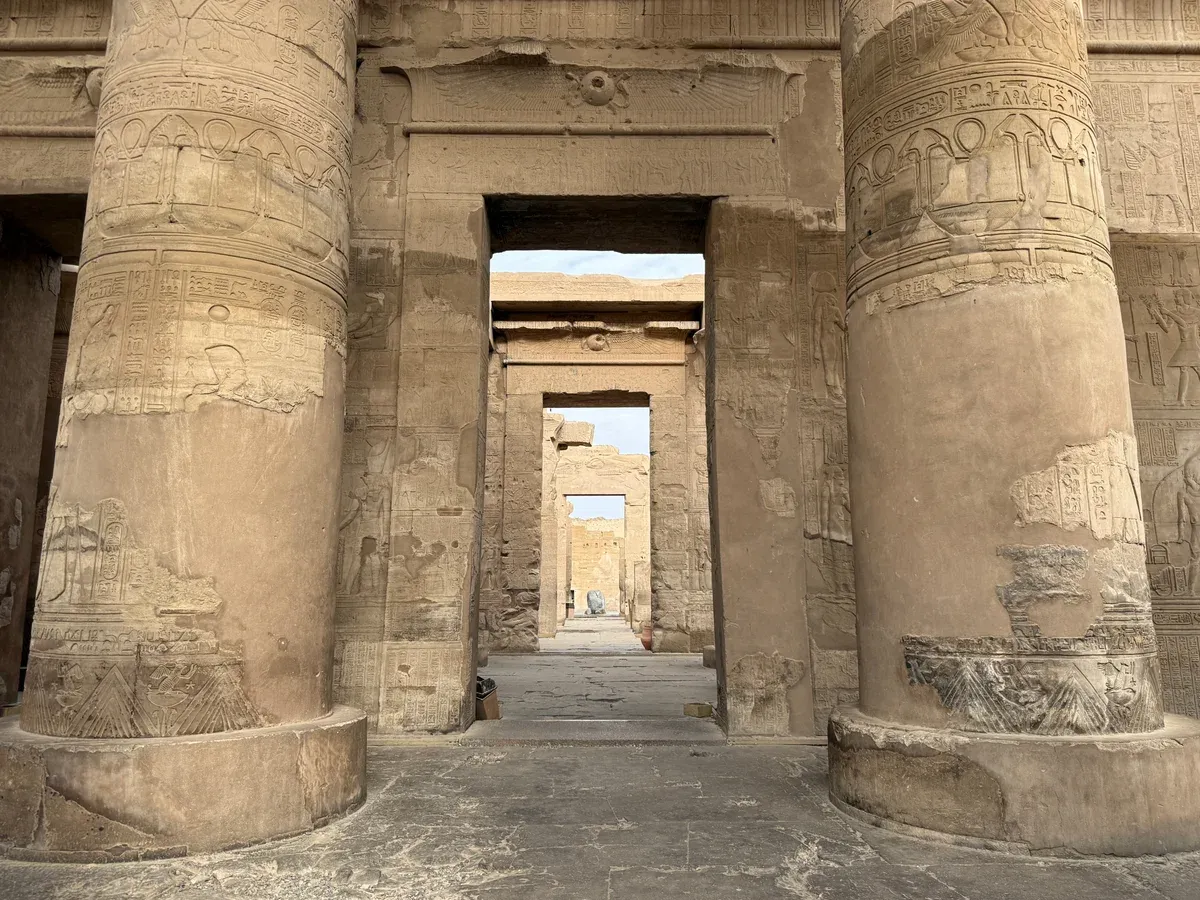
Papyrus-style columns line the halls of the double temple at Kom Ombo. Photo: Chabe01, CC BY-SA 4.0, via Wikimedia Commons
Quick answer Kom Ombo at a glance
Kom Ombo Temple stands on the Nile 50 km (31 mi) north of Aswan and was built in the Ptolemaic period, from 180 to 47 BC. It is a double temple: the southern half belongs to the crocodile god Sobek and the northern half to the falcon god Haroeris, each with its own axial passage and sanctuary. A foreign adult ticket costs EGP 450, a student ticket EGP 225, and the Crocodile Museum next door is covered by the same ticket. The ministry lists the temple, with the Crocodile Museum inside it, as open daily from 7:00 AM to 9:00 PM.
Key takeaways
- See how a Kom Ombo stop fits the wider journey in the guide to Edfu Temple, the other big temple stop on the river.
- Compare Nile river cruises that call at Kom Ombo, from 2-night small-group sailings to 7-day routes.
- Check what your fare covers on what the price includes, because most listings exclude the EGP 450 entrance fee.
- Pair the temple with the rest of the town in the roundup of things to do in Aswan, 50 km to the south.
A Temple for Two Gods
Kom Ombo is a double temple built symmetrically for two deities at once. Everything about its plan is doubled.
Why the Temple Is Doubled
The temple has two principal entrances, which suggests two temples united in one building. The southern half belongs to Sobek, the crocodile god, worshipped here with his wife Hathor and their son Khonsu. The northern half belongs to the falcon god Haroeris, which means Horus the Elder. The Egyptian ministry spells the same name Harwer. Each half has its own parallel axial passage, and each passage ends in its own sanctuary. The larger part of the temple was dedicated to Haroeris and the other deities of the Ombite nome.
The name of the town explains the setting. Kom comes from the Arabic word for mound, and Ombo comes from the ancient Egyptian Nubt, meaning golden city.
Who Built It and When
The temple you walk through today was built in the Ptolemaic period, from 180 to 47 BC. Ptolemy VI Philometor began the work. A Greek inscription credits Ptolemy VI Philometor and Cleopatra II with the erection or restoration of the sekos, dated 180 to 145 BC. Ptolemy XIII built the inner and outer hypostyle halls, and most of the decoration was completed under Ptolemy XII Neos Dionysos.
The Ptolemies were not the first to build here. An earlier temple stood at Kom Ombo in the New Kingdom, around 1550 to 1069 BC. Time has not been kind to the later building. Much of it was destroyed by the Nile, by earthquakes and by later builders who reused its stones. Copts defaced some interior reliefs when they used the temple as a church. The French archaeologist Jacques de Morgan cleared and restored the buildings in 1893.
Sources: Egyptian Ministry of Tourism and Antiquities, Wikipedia
Reliefs, the Nilometer and the Crocodiles
Kom Ombo rewards a slow walk. The carved walls record medicine, timekeeping and the river itself, and the museum beside the temple holds the mummified crocodiles.
The Carvings Worth Finding
Three reliefs matter more than the rest. On the inner face of the rear wall, a carving probably shows a set of surgical instruments, and the ministry dates this medical scene to the 2nd century AD. Elsewhere a relief calendar shows the days of the month and the inundation season, a carved schedule of the Egyptian year. Alongside these, the standard Ptolemaic decoration shows the double worship of Sobek and Haroeris in their mirrored halves.
At the temple stands a Nilometer used to measure the level of the river waters. The Kom Ombo Nilometer is a circular well linked to the Nile by underground channels. It is one of several along the river, including two on Elephantine Island near Aswan.
The table below pulls the highlights together so you can match each feature to its location and its significance before your guide starts walking.
| Feature | Where | Why it matters |
|---|---|---|
| Surgical instruments relief | Inner face of the rear wall | A medical scene dated by the ministry to the 2nd century AD |
| Relief calendar | Temple walls | Shows the days of the month and the inundation season, a carved Egyptian year |
| Nilometer | At the temple | A circular well with underground channels used to measure the Nile's level |
| Double sanctuaries | Both halves | Two parallel axial passages, one for Sobek and one for Haroeris, each ending in its own sanctuary |
| Crocodile Museum | Next to the temple | Mummified crocodiles, the longest measuring 4.30 m, covered by the temple ticket |
The Crocodile Museum
The Crocodile Museum opened in 2012 in a building next to the temple that reportedly served as a police station before conversion. It holds the mummified crocodiles associated with the Sobek cult at Kom Ombo. Sources disagree on the numbers. Ahram reported 22 mummies on display of about forty found in Aswan, while Wikipedia says three hundred mummies were found in the vicinity with a few displayed. Take both as approximate.
The ministry lists the extremes: the longest mummy in the museum measures 4.30 m and the smallest 2 m. The display also includes crocodile fetuses, eyes and golden and ivory teeth. You do not need a second ticket. The ministry price list states that the Crocodile Museum is covered by the Kom Ombo temple ticket, so see it on the same visit.
Sources: Egyptian Ministry of Tourism and Antiquities, Ahram Online
Temple of Kom Ombo معبد كوم امبو - Egypt
A traveller walks through the double Temple of Kom Ombo beside the Nile. Third-party video by rndomn8. This site did not shoot it and has no relationship with the creator.
Tickets and Hours
Kom Ombo is straightforward to buy into. One ticket covers the temple and the Crocodile Museum, and both keep long hours.
What You Pay and When It Opens
The figures below come from the Egyptian Ministry of Tourism and Antiquities price list and site page. A foreign adult pays EGP 450 for the Kom Ombo temple, and that same ticket covers the Crocodile Museum, so there is no separate museum charge. Students pay EGP 225. If you arrive by car, parking runs EGP 25 for a car, EGP 50 for a minibus and EGP 100 for a bus.
The temple and the museum are open daily from 7:00 AM to 9:00 PM, and the ticket window closes at 8:00 PM, so plan to be at the window before then. For heat planning, Aswan averages a daily high of 36.4 C (97.5 F) in October and 41.9 C (107.4 F) in July.
| Ticket | Price | Hours |
|---|---|---|
| Foreign adult, temple and Crocodile Museum | EGP 450 | Daily 7:00 AM to 9:00 PM, ticket window closes 8:00 PM |
| Student, temple and Crocodile Museum | EGP 225 | Daily 7:00 AM to 9:00 PM, ticket window closes 8:00 PM |
| Parking, car | EGP 25 | Not stated |
| Parking, minibus | EGP 50 | Not stated |
| Parking, bus | EGP 100 | Not stated |
Sources: Ministry price list, Ministry site page
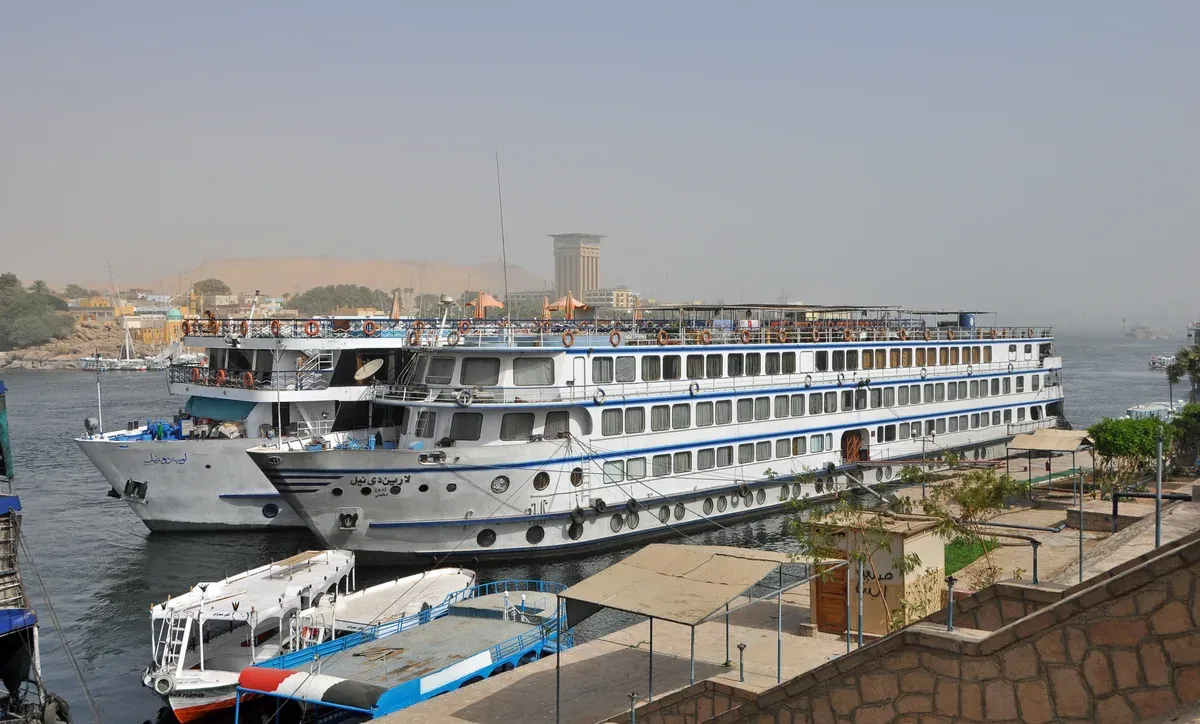
Cruise ships lie moored along the Aswan corniche. Photo: Marc Ryckaert, CC BY 3.0, via Wikimedia Commons
Kom Ombo on a Nile Cruise
The temple sits on the water's edge, and LiveAboard calls the classic Luxor to Aswan itinerary with stops at Edfu and Kom Ombo the most popular choice for first-time Nile cruisers.
Which Cruises Stop Here and What the Ticket Costs You
The classic itineraries between Aswan and Luxor list Kom Ombo, but the fare rarely covers the entrance fee. Of the tours compared here, the 2-Night Small-Group Cruise at $590 per person stops at Kom Ombo on its Aswan to Luxor route, and its listing excludes entrance fees, so budget the EGP 450 separately. The 3-Night Cruise with Temple Tickets at $600 per person (plus $200 per person for travel from December 20 to January 2) is the clear exception on the 3-night route: its listing includes all entrance fees to the named sights, Kom Ombo among them. On the upstream direction, the 4-Night Luxor to Aswan Cruise at $950 per person, with $100.83 in mandatory charges added at checkout, calls at Kom Ombo with fees paid on site.
Two slower boats also stop. The Luxury Dahabiya Cruise at $1,100 per person includes entrance fees for the sites in its itinerary, Kom Ombo included. The Overnight Felucca from Aswan from $25 per person visits Kom Ombo for about 1 hour on its 3-night option, with entry tickets excluded. For the full catalog of sailings, browse Nile river cruise.
If your stop is in the evening, pack a light layer, covered shoulders and comfortable walking shoes.
| Cruise | Card price | Kom Ombo entry fee |
|---|---|---|
| 2-Night Small-Group Cruise | $590 per person | Not included, pay EGP 450 on site |
| 3-Night Cruise with Temple Tickets | $600 per person | Included in the fare |
| 4-Night Luxor to Aswan Cruise | $950 per person | Not included, paid on site |
| Luxury Dahabiya Cruise | $1,100 per person | Included for itinerary sites |
Sources: LiveAboard Nile cruise guide, tour listings on the booking platforms
Dos and Don'ts at Kom Ombo
Five things to do and four to skip, each with the reason.
Do
- Do cover shoulders and knees, because LiveAboard advises covered shoulders and knees at religious sites in Egypt and Kom Ombo was later used as a church.
- Do carry Egyptian pounds in cash, because the official currency is the Egyptian Pound and LiveAboard advises using it for most personal expenses, including the EGP 450 ticket.
- Do visit in the evening if your ship moors then, because the temple is listed as open until 9:00 PM and the evening is cooler than the middle of the day.9 C (107.4 F) in summer.
- Do find the surgical instruments relief on the rear wall, because the ministry dates the medical scene to the 2nd century AD and it is easy to miss without looking.
- Do tip your guide and driver separately on shore excursions, because tipping or baksheesh is customary in Egypt and many operators collect crew tips separately from excursion tips.
Don't
- Don't fly a drone over the site, because the FCDO says flying without Ministry of Defence permission is illegal, with up to 7 years' prison or fines of EGP 5,000 to 50,000.
- Don't assume your cruise fare includes the ticket, because most listings exclude temple entrance fees and only some tours, such as the 3-Night Cruise with Temple Tickets, include them.
- Don't expect drinks on board to be covered, because several cruise listings exclude even water, so bring your own supply for the day.
- Don't photograph military sites, because the FCDO says military sites including the Suez Canal must not be photographed.
Kom Ombo Temple FAQ
What does the name Kom Ombo mean?
Kom comes from the Arabic word for mound, and Ombo comes from the ancient Egyptian Nubt, meaning golden city.
When was the Temple of Kom Ombo built?
The standing temple was built in the Ptolemaic period from 180 to 47 BC, begun under Ptolemy VI Philometor, on the site of a New Kingdom temple from around 1550 to 1069 BC. Its history sits alongside Edfu Temple, the other great Ptolemaic stop on the river.
How much does a Kom Ombo ticket cost?
The ministry price list shows EGP 450 for a foreign adult and EGP 225 for a student, with the Crocodile Museum covered by the same ticket. Check what your fare covers on what the price includes.
What are the opening hours of Kom Ombo Temple?
The ministry lists the temple and the Crocodile Museum inside it as open daily from 7:00 AM to 9:00 PM, with the ticket window closing at 8:00 PM. Times and stops for the whole route are on the Nile river cruise.
Why is Kom Ombo famous for crocodiles?
The temple's southern half belongs to Sobek the crocodile god, and the Crocodile Museum next door displays mummified crocodiles, the longest measuring 4.30 m. Nearby Aswan offers more river culture, from the Nubian village at Aswan to the temple island of Philae.
Do all Nile cruises stop at Kom Ombo?
The classic Luxor to Aswan itinerary with stops at Edfu and Kom Ombo is the most popular choice for first-time cruisers, but short point-to-point sailings may skip it. Compare the boats that call here in the Nile river cruise.