 Nile River Boat Cruise
The Aswan High Dam: A Visitor Guide
The Aswan High Dam is the dam that holds back the Nile at Aswan and created Lake Nasser. This guide covers when and why it was built, its size, the Soviet role, the Nubian displacement, what you actually see on a visit, the entry ticket, and which Nile river cruise itineraries stop here. Figures come from official and reference sources, and every cruise price is the card price on this site. For the temple near the dam, see the guide to Philae Temple. The bookable tours are compared on Nile river cruises.
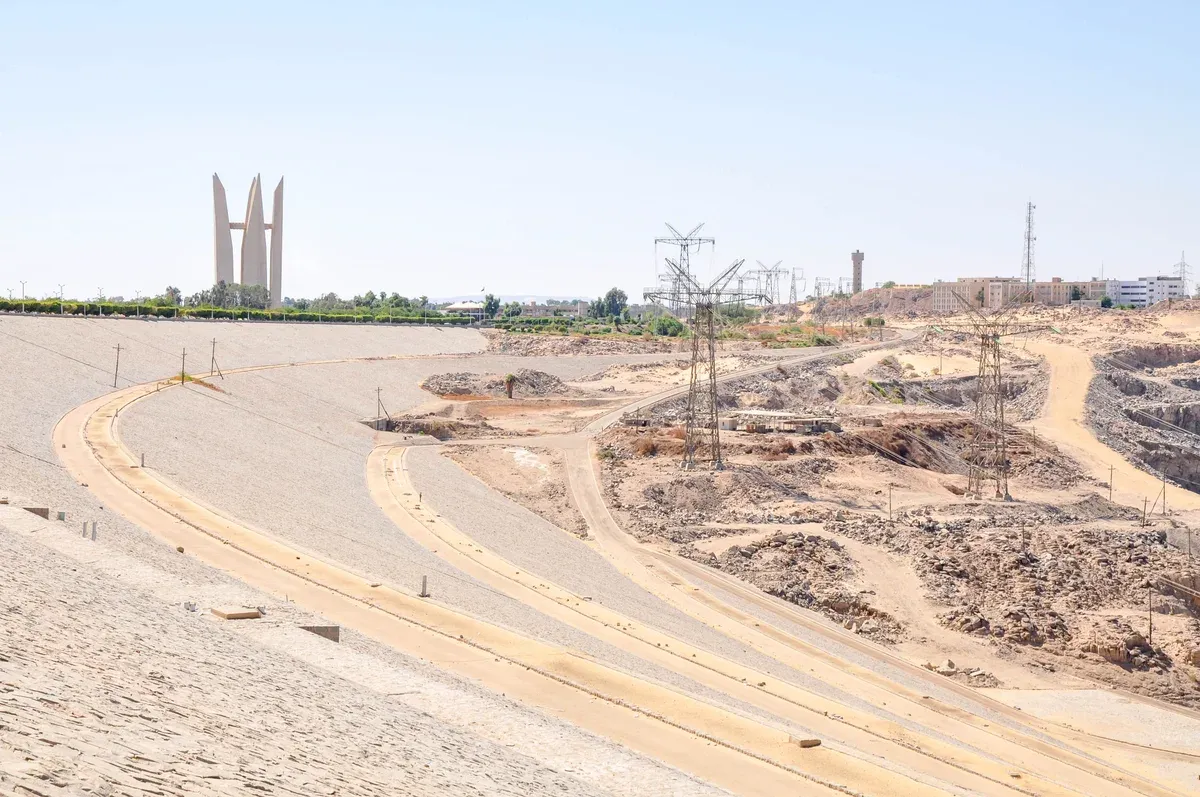
The long rockfill embankment of the Aswan High Dam leads to the Lotus monument on the west bank. Photo: Jorge Láscar from Melbourne, Australia, CC BY 2.0, via Wikimedia Commons
Quick answer The High Dam in brief
The Aswan High Dam is a rock-fill dam on the Nile at Aswan, 111 m high and 980 m wide at the base. Construction began on 9 January 1960 and it was completed on 21 July 1970. It created Lake Nasser, the world's second-largest human-made lake, and its 12 generators produce 2,100 MW. Wikivoyage lists entry at LE200.
Key takeaways
- See how the temple tickets cruise covers the High Dam stop with entrance fees included in the price.
- Compare it with other stops in Nile cruises of Nile river cruises.
- Check what the price covers before you book, because most cruises exclude the dam's entry ticket.
- Pair the dam with things to do in Aswan on the same day.
The Dam in Figures
These figures come from the Wikipedia Aswan Dam article and other reference sources.
Size and Capacity
The table pulls together the headline figures for the Aswan High Dam, from its construction dates to the output of its power station. It is a rock-fill structure, not a concrete wall, and it used 43,000,000 cubic metres of material. Anwar Sadat inaugurated the lake and dam in 1971. The reservoir behind it filled in stages, starting in 1964 and reaching full capacity in 1976.
Whether the Aswan Dam is the largest dam in the world has no simple yes here. What the reference sources do say is that Lake Nasser behind it is the world's second-largest human-made lake, covering 5,250 km2 with a capacity of 132 km3 of water. The power station runs 12 generators of 175 MW each, for a total of 2,100 MW.
| Figure | Value |
|---|---|
| Construction start | 9 January 1960 |
| Completed | 21 July 1970 |
| Height | 111 m |
| Width at base | 980 m |
| Width at crest | 40 m |
| Material used | 43,000,000 cubic metres |
| Reservoir (Lake Nasser) surface area | 5,250 km2 |
| Reservoir capacity | 132 km3 |
| Power station | 12 generators of 175 MW each, 2,100 MW total |
| Soviet credits | about 425 million dollars |
| Egyptian engineers and workers | about 25,000 |
| Lake Nasser depth | average 25.2 m, maximum 130 m |
Why It Was Built and What It Changed
Egypt needed to control the Nile flood and store water for irrigation, and to generate power. The earlier attempt was the Aswan Low Dam, completed in 1902, which Sir William Willcocks designed and John Aird and Co. built. That dam is 1,950 m long and 36 m high above the original riverbed. It was raised twice, by 5 m between 1907 and 1912 and by 9 m between 1929 and 1933, but it could not store enough water for a growing country. The High Dam sits about 6 km upstream of the Low Dam according to Wikivoyage.
The Soviet Union played the central financing and engineering role, providing about 425 million dollars in credits along with Soviet technicians and heavy machinery. Nikolai Malyshev of Hydroproject designed the dam. About 25,000 Egyptian engineers and workers built it alongside them. What changed was the river itself: the annual flood was replaced by a managed release, electricity came at scale, and the water backed up into a reservoir around 500 km long, a figure sources place between 479 and 550 km.
Lake Nasser and the Nubian Story
The lake behind the dam is a destination in its own right, and its creation carried a human and archaeological cost that every visitor should know about.
The Lake Itself
Lake Nasser is named after Gamal Abdel Nasser, the second President of Egypt. It covers 5,250 km2, stores some 132 km3 of water, has an average depth of 25.2 m and a maximum depth of 130 m. The Egyptian part holds about 83 percent of the total, and the Sudanese call their smaller portion Lake Nubia.
The lake's length is one figure the sources do not agree on. The Wikipedia Aswan Dam article says 500 km while the Lake Nasser article says 550 km, so treat it as roughly 500 km. Today the lake is a tourist destination for recreational fishing, sightseeing cruises and visits to relocated monuments such as Abu Simbel, which sits on its shore south of Aswan and is not on the river route between Luxor and Aswan. A ferry also sails once or twice a week across the lake to Wadi Halfa in Sudan, and it does not call at Abu Simbel.
The Displacement of the Nubians
The rising water moved people as well as temples. Wikipedia says the Aswan High Dam displaced 100,000 Nubians in Egypt and Sudan. In Egypt, about 50,000 Nubians were moved to New Nubia near Kom Ombo and Edfu. In Sudan, 50,000 to 70,000 Nubians were moved, including to New Wadi Halfa. Egypt began compensating displaced Nubians in 2019 and 2020, decades after the flooding.
The Nubian story did not end with the move. Nobiin, the Nubian language, has about 690,000 native speakers and one community lives near Kom Ombo. Nubians are credited with inventing the Nubian vault, a building technique still visible in the domed mud brick houses of villages you can visit today. You can learn more in the guide to the Nubian village Aswan or at the Nubia Museum, which was inaugurated on 23 November 1997, covers 50,000 square metres and won the Aga Khan Award for Architecture in 2001.
The Rescued Temples
An international campaign moved the monuments that stood in the flooding zone. The rescued monuments on Lake Nasser include the temples of Kalabsha, Wadi es-Sebua and Amada, and the most famous rescue of all, Abu Simbel. Not everything could be saved. The fortress of Buhen could not be rescued and now lies underwater.
The best-known case is Philae, the island temple of Isis, which was relocated in the late 1970s and reopened on 10 March 1980. The ministry price list shows Philae at EGP 550 for foreign adults and EGP 275 for students, open 7:00 to 16:00. Most Aswan cruises visit Philae and the High Dam on the same day, which is why the two sites appear together on nearly every itinerary out of the city. For full details, see the Philae Temple guide.
Aswan High Dam Egypt's Engineering Marvel and Env
A short film on the Aswan High Dam, how it works and what it changed on the Nile. Third-party video by Chronicles of Fame. This site did not shoot it and has no relationship with the creator.
Visiting the High Dam
A visit to the Aswan High Dam is short. Here is what the ticket costs, what the sources say about hours, and what you actually see.
Ticket and Hours
The ministry price list for Aswan sites does not include a High Dam entry fee, so the only sourced figure is Wikivoyage's, which lists High Dam entry at LE200. Opening hours for the dam are not stated in the published sources. For comparison, the ministry list prices other Aswan sites, and the table shows what the official and reference figures give.
Most cruises from Aswan list the High Dam as a day 1 stop. Note that most cruise listings exclude the entry fee, so you pay the ticket on site. One listing in the comparison includes all entrance fees, and that changes the maths, which is why what the price covers matters before you book.
| Ticket | Price | Hours |
|---|---|---|
| High Dam, foreign adult | LE200, Wikivoyage figure | not stated |
| High Dam, student | not stated | not stated |
| Philae, foreign adult | EGP 550 | 7:00 to 16:00 |
| Philae, student | EGP 275 | 7:00 to 16:00 |
| Unfinished Obelisk, foreign adult | EGP 220 | 7:00 to 16:00 |
| Nubia Museum, foreign adult | EGP 400 | 9:00 to 17:00 |
What You See
The visit has two fixed points. The first is the dam itself, along its crest, with Lake Nasser stretching south behind it. Remember the scale from the table above: 111 m high, 980 m wide at the base, holding back a lake of 5,250 km2. The second is the lotus-shaped monument to Arab-Soviet Friendship, which stands at the dam and marks the partnership that financed and engineered the project. It is the spot for photos.
There is no temple, museum or tomb here, so it is a quick stop, usually paired with Philae and the Unfinished Obelisk, which the ministry lists at EGP 220 for foreign adults. For a full day plan, see the guide to things to do in Aswan. Also worth knowing: Aswan's average summer highs stay above 40 C, so a morning visit is the comfortable one.
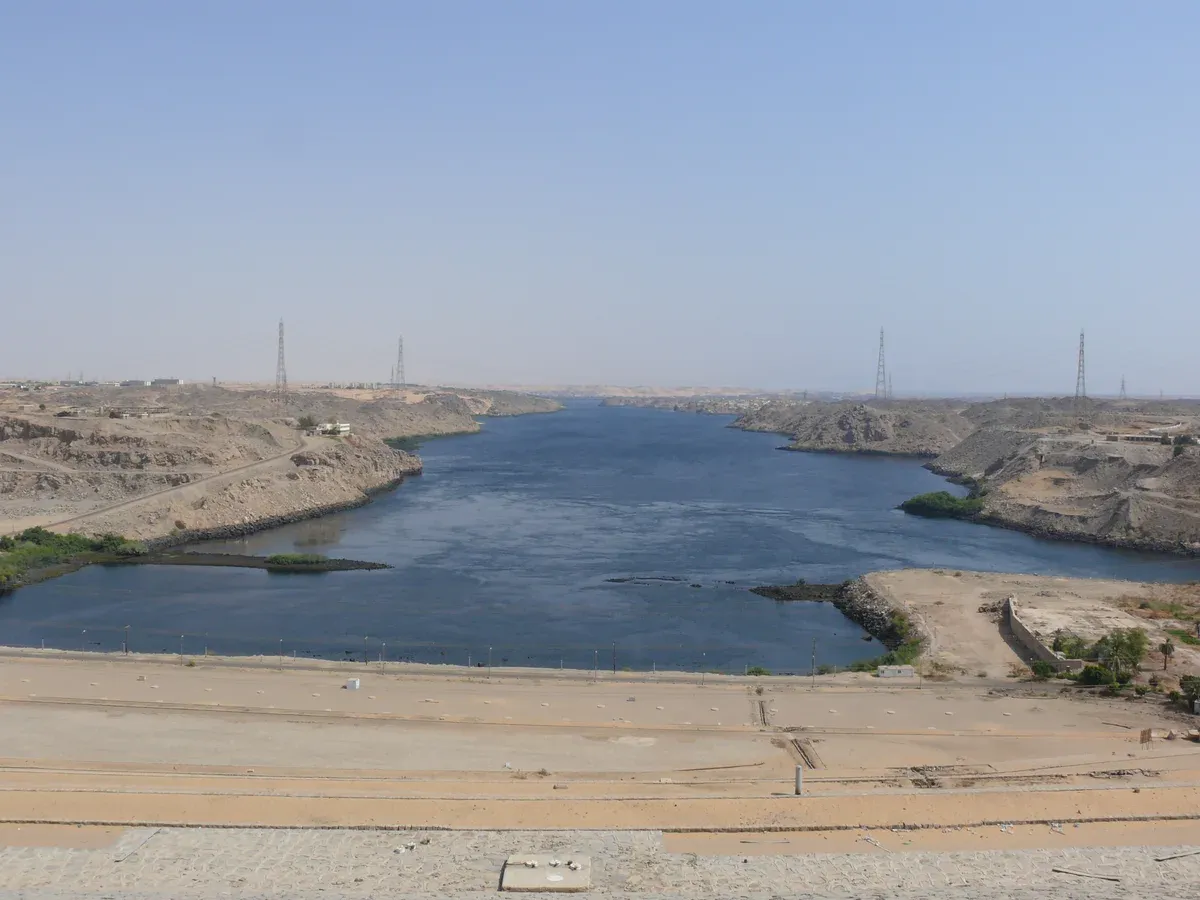
The Nile runs out between desert banks downstream of the Aswan High Dam. Photo: Ad Meskens, CC BY-SA 3.0, via Wikimedia Commons
The High Dam on a Nile Cruise
Most cruises that start in Aswan stop at the High Dam on day 1. The key difference between them is whether the entry ticket is in the price.
Which Cruises Stop Here and What They Charge
The table and notes below compare the cruises that list the Aswan High Dam as a stop, using the card prices on this site and each listing's own statement about entrance fees. Read the entry line carefully, because it is where the money difference sits.
The 3-Night Cruise with Temple Tickets at $600 per person is the only listing with the High Dam as a stop whose price includes entrance fees: it covers all entrance fees to the mentioned sights, Philae, the High Dam, the Unfinished Obelisk, Kom Ombo, Edfu, Karnak, Luxor Temple, the Valley of the Kings and Hatshepsut. Abu Simbel is not included. It is full board with bottled water, two small bottles per person per day, and it carries a free cancellation 24h policy.
Most of the others stop at the dam and exclude the ticket. The 3-Night Cruise with Abu Simbel and Balloon at $340 per person excludes entrance fees to every sight it names, including the Aswan High Dam, so budget the LE200 on site. It also adds $110 in mandatory charges at checkout, a from-price of $450, and the listing does not say what that covers. The 3-Night Cruise with Balloon Ride at $580 per person likewise says entrance tickets to all temples and attractions are paid locally and vary by site. The 2-Night Small-Group Cruise at $590 per person, limited to 18 participants, lists entrance fees as excluded. The same applies to the Nile Cruise from Cairo with Flights at $1,300 per person and the 7-Day Luxor and Aswan Cruise at $1,772 per person, both of which include the High Dam among their stops but exclude entry tickets.
Sources: Wikivoyage Aswan and Egyptian Ministry of Tourism price list
Tips for the High Dam
Simple rules from the sourced facts, so the stop goes smoothly.
Do
- Do check whether your cruise includes entrance fees, because most listings exclude the High Dam ticket and you pay the LE200 on site.
- Do go in the morning, because Aswan's average summer highs stay above 40 C.
- Do plan the dam with Philae and the Unfinished Obelisk the same day, because most Aswan itineraries pair them and Philae opens 7:00 to 16:00.
- Do stop at the lotus-shaped monument to Arab-Soviet Friendship, because it is the photo point that marks the dam's Soviet-built story.
- Do add the Nubia Museum to your Aswan days if you want more on the Nubian story, and it is open 9:00 to 17:00.
Don't
- Don't expect the dam to be the largest dam in the world on the strength of any official claim, because the reference sources only confirm Lake Nasser as the second-largest human-made lake.
- Don't budget only the cruise price, because listings like the $340 cruise add $110 in mandatory charges at checkout and the listing does not say what that covers.
- Don't confuse the High Dam with the Low Dam of 1902, because the Low Dam is 1,950 m long and 36 m high and sits about 6 km downstream.
- Don't plan to reach Abu Simbel from the dam by cruise boat, because Abu Simbel sits on Lake Nasser south of Aswan and the ferry to Wadi Halfa does not call there.
Aswan High Dam FAQ
What is the Aswan High Dam and why is it important?
It is a rock-fill dam on the Nile at Aswan, 111 m high and 980 m wide at the base, completed on 21 July 1970. It controls the flood, stores 132 km3 of water in Lake Nasser and generates 2,100 MW. Most cruises from Aswan stop there, and you can compare them in Nile cruises.
Why was the Aswan High Dam so controversial?
Because it flooded Nubian land. Wikipedia says the dam displaced 100,000 Nubians in Egypt and Sudan, about 50,000 of them moved in Egypt to New Nubia near Kom Ombo and Edfu, and Egypt only began compensating them in 2019 and 2020. The human side of that story continues in villages you can visit, as the Nubian village Aswan guide explains.
Who built the Aswan Dam in Egypt?
The High Dam was designed by Nikolai Malyshev of Hydroproject, with Soviet technicians, heavy machinery and about 425 million dollars in Soviet credits, and about 25,000 Egyptian engineers and workers built it. The earlier Low Dam of 1902 was designed by Sir William Willcocks with John Aird and Co. as contractor. See how the visit fits a sailing in routes: how many nights.
How much does it cost to visit the Aswan High Dam?
Wikivoyage lists High Dam entry at LE200. The ministry price list does not include a High Dam fee, and opening hours are not stated in the published sources. Most cruises exclude the ticket, so check what the price covers before booking.
Which Nile cruises stop at the Aswan High Dam?
Most sailings from Aswan stop there on day 1. The 3-Night Cruise with Temple Tickets at $600 per person is the one listing with the High Dam as a stop that includes all entrance fees to the mentioned sights. Others, like the 3-Night Cruise with Abu Simbel and Balloon at $340 per person, exclude the ticket.
Is the Aswan High Dam worth visiting?
It is a short stop rather than a full sight, with the dam crest and the lotus-shaped monument to Arab-Soviet Friendship as the two points of interest. Its value is as the key to understanding the river you sail, the lake that Abu Simbel sits beside, and the 5,250 km2 of water behind the dam. For the rest of the day, see things to do in Aswan.